Product Updates

Notable changes to our APIs, dashboard and docs. Short on purpose.

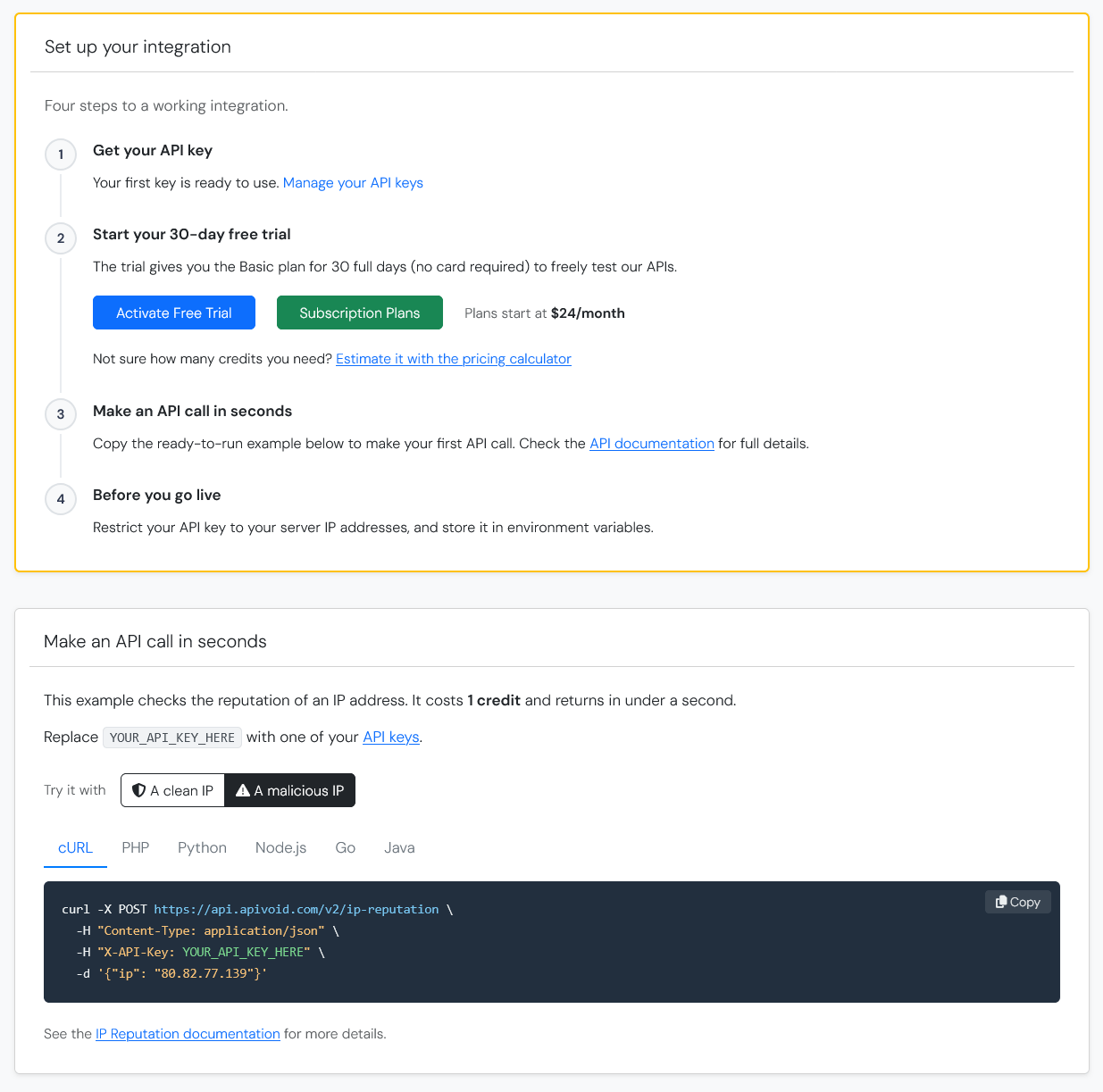
The dashboard home page is now more action-oriented, especially for new accounts. Previously a new user landed on an almost empty page with a "No subscription found" card, two buttons and two empty usage charts. With the new better dashboard you get:

  • A "Set up your integration" card with the four steps to go live: get your API key, start the 30-day free trial, make your first API call, and restrict your key before going to production
  • A "Make an API call in seconds" card with a ready-to-run example in curl, PHP, Python, Node.js, Go and Java, a copy button, and a toggle to try it against a clean or a malicious IP
  • "Questions before you start?" and "Useful links" cards pointing to the FAQs, API documentation, pricing calculator, service status, changelog and support

Paying customers also get the "Make an API call in seconds" card, a new "Switch to another plan" link on the Subscription Plan card, and FAQs and Service Status links in Quick Actions.

The new dashboard home page for a new user with the Set up your integration steps and the API call example
The new dashboard home page for a new account.

A new round of improvements landed on several API services, including Email Verify, Domain Reputation, DNS Lookup, SSL Info, Domain Age, IP Reputation and URL Reputation. The most notable changes are on Email Verify API with better should_block score and detection of free and disposable emails; and on IP Reputation API with improved detection of residential IP addresses and proxies; and faster response times on the other APIs.

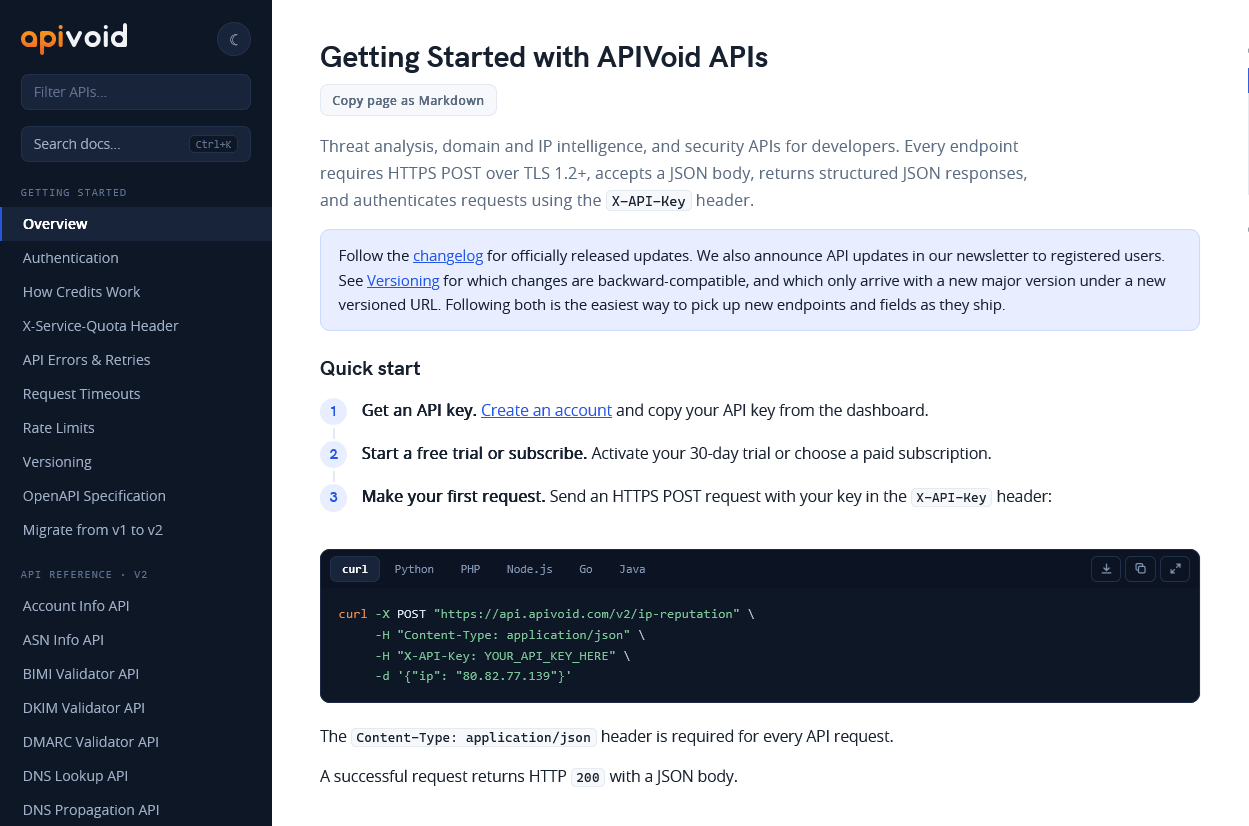
We released the new API documentation. Every API reference page (e.g. IP Reputation API) now ships with copy-paste examples in curl, Python, PHP, Node.js, Go and Java, and has a "Copy page as Markdown" button so you can drop the docs straight into your coding agent.

  • Rate limits, and what happens when you hit them
  • API errors and how to handle retries properly
  • How credits are consumed, per endpoint
  • Request timeouts and the X-Service-Quota header
  • Every response field, for every endpoint, explained
  • The full OpenAPI specification

All pages have their own URL and are shareable.

The new APIVoid API documentation page with code examples
The new API documentation page with copy-paste code examples.

The TLS Check API has a new request parameter, "scan_ciphers": true (disabled by default), that scans the full cipher suite of every active TLS version. Combine it with the SSL Info and Security Headers APIs for a fuller picture of a host's security posture.

Scan time and cost

A full cipher scan takes about 5 seconds on average and up to 30 seconds in the worst case with some domains, and consumes 1 extra credit when enabled.

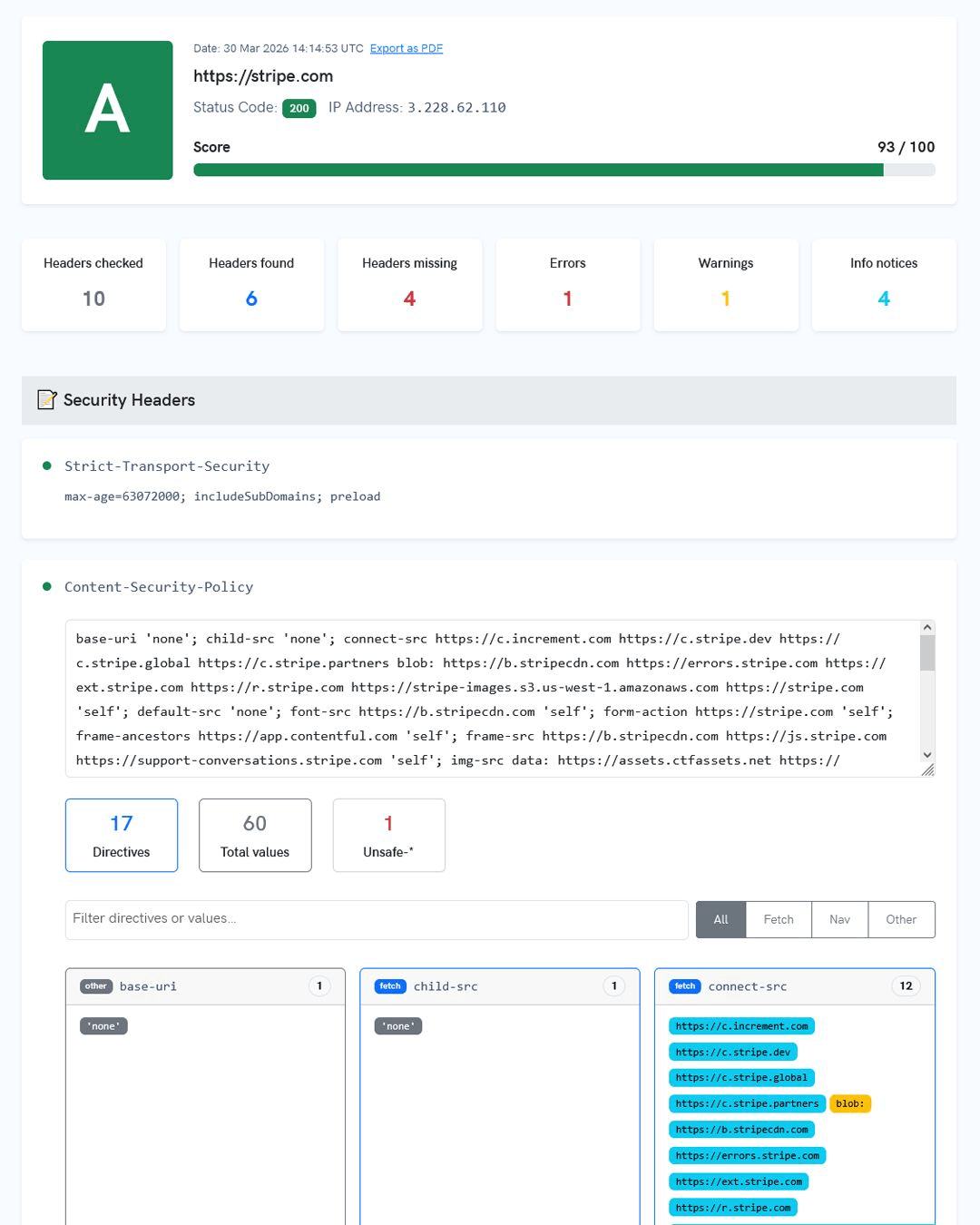
We introduced the Security Headers API, a new endpoint that analyzes HTTP response headers to evaluate the security posture of a website. It returns a detailed assessment with the identified issues, a numerical score and an overall security grade to help you harden your web applications.

You can try it for free with the new Security Headers Checker test page.

The Security Headers Checker tool showing a security grade and identified issues
The Security Headers Checker test page.

As requested by many customers, you now receive an email when your monthly credit usage reaches 80% before the next reset, and another one when credits are fully exhausted (100% usage). We also send an email notification when a past-due subscription is canceled.

The URL Status API now returns much richer data for URL analysis and redirect tracking. It also automatically unwraps the original URL from email gateway protection links (Proofpoint, Barracuda, etc.) and scans it directly, skipping the gateway URL.

  • Extract internal and external links categorized by tag (include_links)
  • Extract parsed HTML forms (include_forms)
  • Favicon base64 file, MD5 hash, size and dimensions (include_favicon_details)
  • The og:image base64 file, MD5 hash, size and dimensions include_og_image_details
  • SSL revocation check (check_ssl_revocation) plus new revoked field
  • Plain-text response body (include_response_body_text)
  • follow_custom_redirects, follow_meta_redirects, follow_header_redirects
  • New redirect chain fields redirected_from, hop, chain_status, unwrapped_url
  • More HTML metadata (author, og_url, googlebot, fb_app_id, etc.)

The redirect_stats object has been refactored and a new request_stats object reports total, failed and slow requests, SSL errors and average/maximum elapsed time. Each include_* option, when enabled, adds a new JSON field to the response. All new parameters and response fields are described in the API documentation.

During the past months we gradually released 12 new API services:

The Account Info API (see the API docs) returns details about your account such as remaining credits, the next reset date and credit usage for the past 30 days and 3 months. It doesn't consume credits and allows up to 1 request per second.

The IP Reputation API received a large batch of new IP insights, better proxy and VPN detection, classification of search engine bots, and a new scanning engine (SpamRATS).

  • Detection of residential proxies and relays (is_residential_proxy, is_relay)
  • Full asn object with name, route, organization, country, abuse email, etc
  • Detection of search engine bots, fake bots, Google services, common crawlers
  • Detection of AWS and edge services, public DNS resolvers and Spamhaus DROP ranges
  • New disable_reverse_dns option for faster response

The Email Verify API is faster and better at detecting disposable and suspicious emails. The response now includes many new fields that help you score an address, such as system_address, noreply_address, canonical_email, public_domain, student_email, spf_strict and spf_qualifier, the domain split into root_domain, subdomain and tld, and username statistics like digits, letters, dots, underscores and hyphens count, or whether the username contains only digits or a celebrity name.

We improved the detection of suspicious web shops, plus we added new insights in the response, including SSL certificate details, security headers analysis (HSTS, CSP, cookies, exposed server versions, etc.), DNSSEC status and domain age in security_checks.

Added new request options and resposne fields on URL Status API:

  • custom_proxy to route the request through your own proxy URL
  • include_response_body (base64 HTML) abd clean_page_content
  • include_response_headers, which also returns parsed cookies
  • use_http2 and follow_external_redirects
  • New protocol, url_parts and domain_parts fields
  • Improved URL status classification

URLs containing a username:password@ component or a punycode domain are now blocked, and user_agent accepts only desktop (default) or mobile.

  • New "Limit Credits" action on API keys to cap the credits a key can consume
  • New "End Trial Period" button to end the trial before it expires
  • New "Delete Account" option on the Settings page to request account deletion
  • Default API keys quota raised to 2 on the Basic plan
  • X-Service-Quota header now includes available= and overage-value=
  • APIs now accept application/json; charset=utf-8 as content type

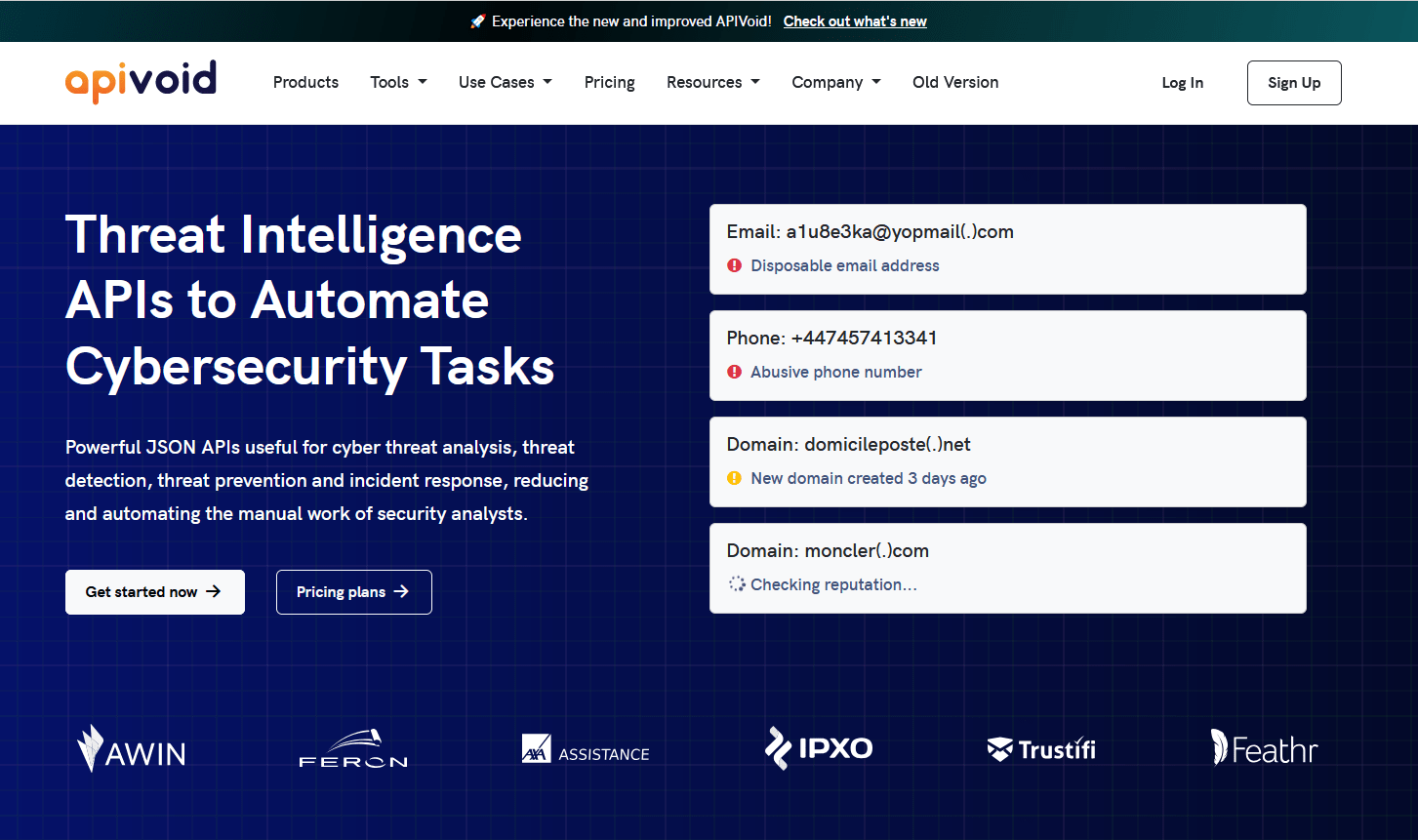
Today we released a completely new version of APIVoid: a redesigned website and user dashboard, monthly and yearly subscriptions with credits that reset every month, a simple pricing calculator to estimate the right plan, and all API services rebuilt on new v2 endpoints (POST requests with JSON payloads, X-API-Key header, flatter JSON responses). The old v1 dashboard and API endpoints will remain available until February 2026 to allow customers to move to v2.

The new APIVoid website released in February 2025
The new APIVoid website and dashboard, February 2025.

© 2019-2026 NoVirusThanks Company Srl